
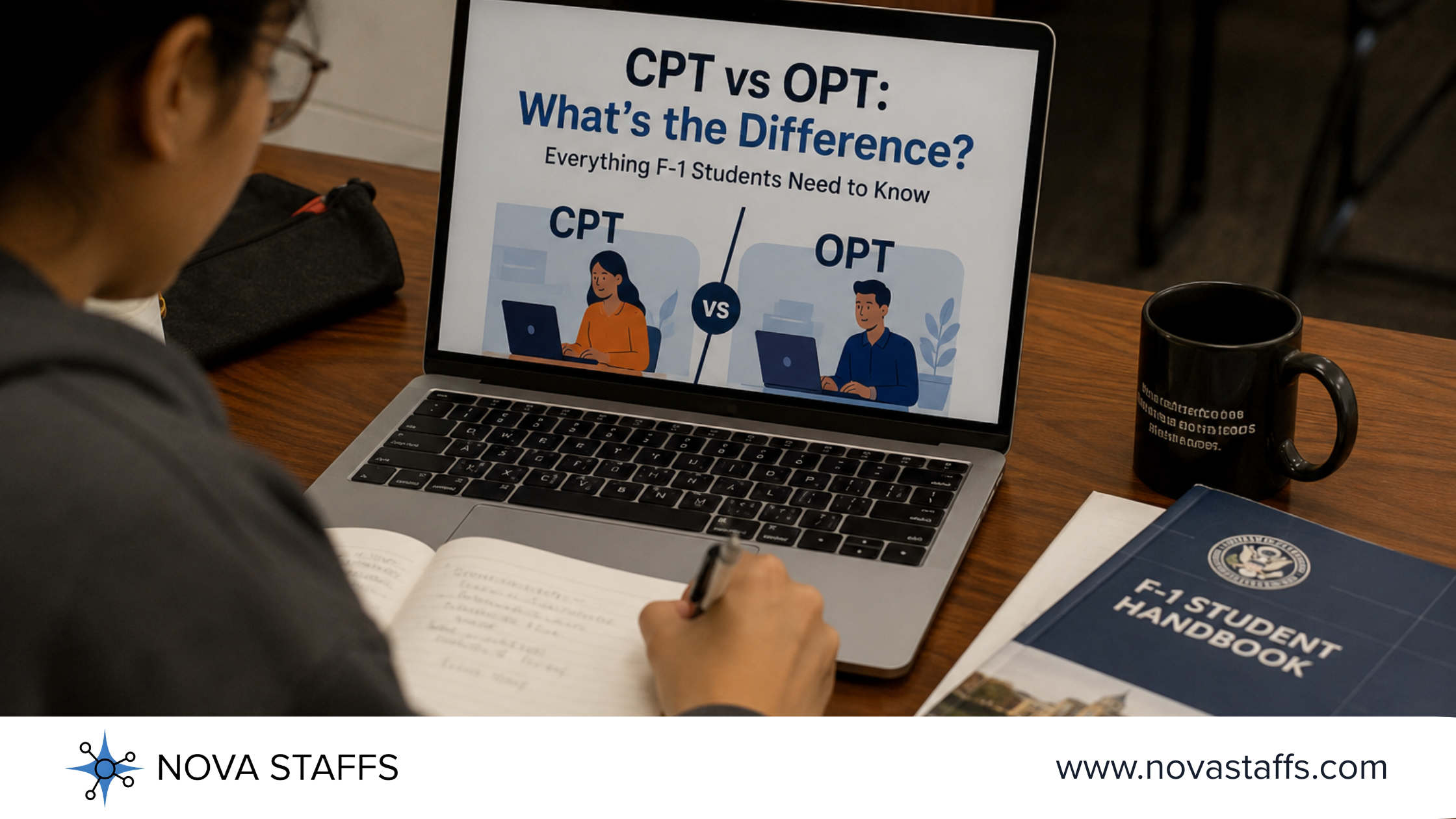
If you're an F-1 student studying in the United States, you've probably heard the terms CPT and OPT more than once. Both programs allow international students to gain valuable work experience while studying or after graduation, but they serve different purposes. Choosing the right option at the right time can make a significant difference in your career journey.
Understanding CPT vs OPT is essential because each program has different eligibility requirements, application procedures, work restrictions, and timelines. Whether you're preparing for an internship, planning your first full-time job, or exploring long-term career opportunities in the U.S., knowing how these work authorizations function will help you make informed decisions.
At Nova Staffs, we help international students navigate their career paths by connecting them with employers, preparing ATS-friendly resumes, and providing job placement support. This guide explains everything you need to know about CPT vs OPT in simple terms so you can confidently plan your next career move.
Curricular Practical Training (CPT) is a temporary employment authorization that allows F-1 students to work while they are still enrolled in their academic program. The employment must be directly related to your major and should be considered an important part of your curriculum.
Many students use CPT for internships, cooperative education programs, clinical placements, or other practical training opportunities required by their university.
Some common examples include:
Since CPT is connected to your academic program, your university's Designated School Official (DSO) must approve your employment before you begin working.
Optional Practical Training (OPT) is another employment authorization available to F-1 students, but unlike CPT, it provides flexibility to work either during or after completing your degree.
Most students apply for Post-Completion OPT, which allows them to gain practical work experience after graduation. OPT gives graduates an opportunity to apply classroom knowledge in real-world professional environments.
Students can work in positions directly related to their field of study and gain valuable U.S. work experience before pursuing longer-term employment opportunities.
The biggest difference between CPT vs OPT is the timing.
CPT is designed for students who want to gain work experience while completing their degree, whereas OPT is generally used after graduation.
Here is a simple comparison:
| Feature | CPT | OPT |
|---|---|---|
| Available During Study | Yes | Yes (Limited) |
| Available After Graduation | No | Yes |
| Requires Job Offer | Yes | No (before applying) |
| University Approval | Required | Required |
| USCIS Approval | Not Required | Required |
| Employment Related to Major | Yes | Yes |
| Internship Requirement | Often Yes | No |
Although both programs provide valuable work experience, your academic goals and career plans will determine which option is more suitable.
Understanding CPT vs OPT eligibility is one of the most important steps before applying.
To qualify for CPT, students generally need to:
Some graduate programs may allow CPT earlier if practical training is part of the curriculum.
Students applying for OPT generally must:
Unlike CPT, students can apply for OPT even if they have not yet secured a job offer.
Many students wonder about CPT or OPT for international students because both programs offer valuable opportunities.
The answer depends on your academic stage and career goals.
Many students actually use both programs during different stages of their education.
For CPT vs OPT for F-1 students, understanding your university's policies is just as important as understanding federal regulations.
Every institution may have slightly different CPT approval procedures, deadlines, and documentation requirements. While immigration rules remain consistent, university processes often vary.
Before applying, students should always:
Planning ahead helps avoid unnecessary delays that could affect internship or employment opportunities.
CPT offers several advantages for students who want to gain professional experience before graduation.
Some of the biggest benefits include:
Students who complete internships through CPT often enter the job market with stronger practical skills than graduates without internship experience.
OPT provides significant career advantages after graduation.
Some key benefits include:
For many graduates, OPT becomes the first step toward building a long-term professional career in the United States.
Finding the right job is only one part of your journey. Preparing for interviews, building a strong resume, and understanding employer expectations are equally important.
At Nova Staffs, we help international students in USA build ATS-friendly resumes, prepare for interviews, connect with employers, and discover career opportunities that align with their education and professional goals.
Whether you're preparing for your first internship through CPT or searching for full-time opportunities during OPT, having the right career support can improve your confidence and increase your chances of success.
Understanding CPT vs OPT is essential for every F-1 student planning to study and work in the United States. While both programs provide valuable opportunities to gain practical experience, they are designed for different stages of your academic and professional journey. CPT allows you to build industry experience while completing your degree, whereas OPT helps you transition into the workforce after graduation.
At Nova Staffs, we're committed to helping F-1 students succeed beyond the classroom. From creating ATS-friendly resumes and preparing for interviews to connecting students with employers, our team supports you throughout your career journey. Whether you're applying for CPT, starting your OPT, or exploring your next career opportunity, Nova Staffs is here to help you take the next step with confidence.
The main difference between CPT vs OPT is when you can work. Curricular Practical Training (CPT) is used while you are still studying and is part of your academic curriculum. Optional Practical Training (OPT) is typically used after graduation, allowing F-1 students to gain practical work experience related to their field of study.
The CPT vs OPT eligibility requirements differ slightly. CPT requires a valid F-1 status, completion of at least one academic year (in most cases), a job offer, and approval from your university's Designated School Official (DSO). OPT also requires valid F-1 status and one academic year of study, but students must receive approval from USCIS and an Employment Authorization Document (EAD) before starting work.
Choosing CPT or OPT for international students depends on your academic and career goals. CPT is ideal for internships or practical training during your degree, while OPT is better suited for gaining full-time professional experience after graduation. Many students use both programs at different stages of their education.
Yes. Many F-1 students use both CPT and OPT during their academic journey. Students often complete internships through CPT while studying and then apply for OPT after graduation to continue building professional experience in the United States.
The CPT application process usually involves receiving a job offer related to your major, obtaining approval from your academic department if required, meeting with your Designated School Official (DSO), and receiving an updated Form I-20 with CPT authorization before beginning employment.
Join thousands of successful professionals who found their dream
jobs with Nova Staffs.