
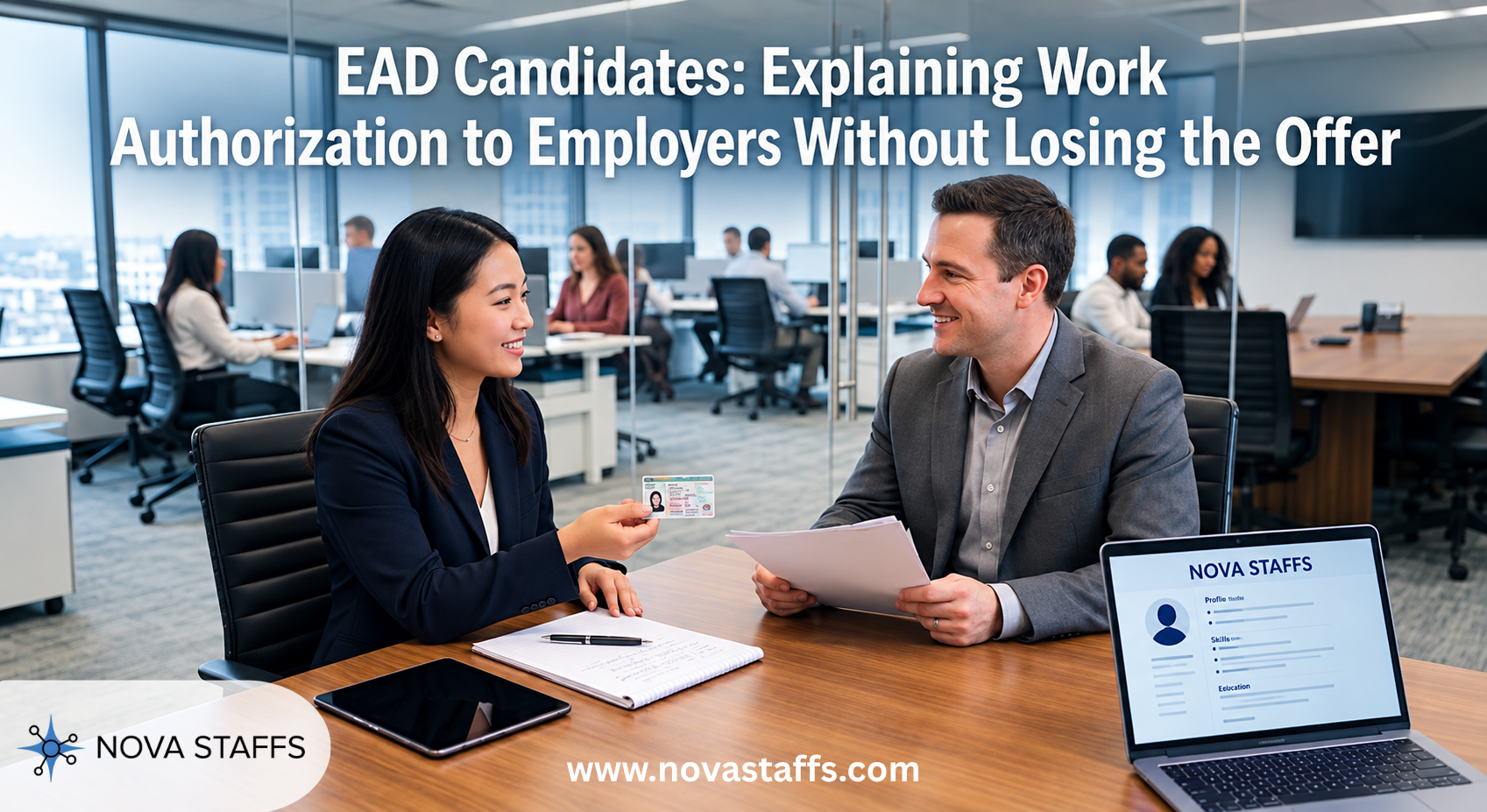
Finding a job in the United States can be challenging for international students, especially when employers have questions about work authorization. For OPT EAD Candidates, explaining employment eligibility clearly and confidently can make a significant difference during the hiring process.
Many F-1 students have the right qualifications, technical skills, and relevant experience but become nervous when recruiters ask questions such as, "Do you require sponsorship?" or "How long are you authorized to work in the United States?"
The problem is often not the candidate's work authorization itself. It is the way the information is communicated. Employers want to understand whether a candidate can legally work, how long the authorization is valid, and whether additional sponsorship may be required in the future. A clear and accurate explanation can help recruiters understand the candidate's situation without creating unnecessary confusion.
In this guide, we will explain how OPT EAD Candidates can discuss their work authorization professionally, answer common employer questions, and approach the U.S. job market with greater confidence.
Optional Practical Training, commonly known as OPT, allows eligible F-1 international students to gain practical work experience related to their field of study.
Students who receive OPT authorization are generally issued an Employment Authorization Document (EAD) by U.S. Citizenship and Immigration Services. The EAD card serves as evidence of employment authorization during the authorized period.
For employers, the important point is simple: they need to determine whether a candidate is authorized to work and complete the required employment eligibility verification process.
The details of a candidate's authorization can vary depending on their situation. For example, some students may have regular post-completion OPT, while eligible graduates in qualifying STEM fields may later qualify for a STEM OPT extension.
Therefore, OPT EAD Candidates should understand their own authorization before applying for jobs or speaking with recruiters.
Work authorization is a standard part of the hiring process in the United States. Recruiters and employers may ask about it early because they need to understand whether a candidate meets their employment requirements.
A candidate may hear questions such as:
These questions can feel stressful, particularly when a candidate believes that mentioning OPT could negatively affect their chances. However, avoiding the question or providing unclear information can create more problems than giving a straightforward explanation. The best approach is to be honest, concise, and professional.
One of the biggest mistakes candidates make is giving recruiters a long explanation about immigration terminology when a simple answer would be more effective.
Your goal should be to communicate three things:
Example: "I am currently authorized to work in the U.S. through OPT and have valid employment authorization."
If applicable, the candidate can then explain their eligibility for a STEM OPT extension. The exact wording should always reflect the candidate's actual situation. OPT EAD Candidates should never claim authorization they do not have or make promises about future immigration status.
Recruiters do not necessarily expect candidates to be immigration experts. They mainly need accurate information that helps them understand employment eligibility.
Instead of simply saying, "I have a visa," provide information relevant to employment authorization.
Less clear: "I am on an F-1 visa."
More relevant: "I am an F-1 student graduate currently authorized to work under OPT, and I have an EAD."
The second explanation directly addresses the employer's concern. Your F-1 status and your employment authorization are related but are not exactly the same thing. Therefore, candidates should be prepared to explain their OPT EAD work authorization rather than relying only on their visa status.
This is one of the most important questions for OPT EAD Candidates. The answer depends on your individual circumstances and the employer's question. Some employers may be asking whether you require sponsorship immediately, while others may be asking whether you will require sponsorship at any point in the future. That distinction matters.
If an employer asks whether you are currently authorized to work, explain your current authorization accurately. If they ask whether you will require sponsorship in the future, answer honestly based on your circumstances. Do not simply say "No" because you currently have OPT authorization if the question is specifically about future sponsorship.
A better approach is to clarify what the employer means when necessary:
"I am currently authorized to work in the U.S. through OPT. Are you asking about current work authorization or future sponsorship requirements?"
This keeps the conversation professional and prevents misunderstandings.
Some candidates worry that mentioning OPT will automatically cause an employer to reject their application. Because of this concern, they may avoid discussing their status until late in the hiring process. That can be risky.
Employers have different hiring policies. Some companies actively hire international graduates and OPT EAD Candidates, while others may have specific requirements regarding sponsorship. Being transparent early can save time for both the candidate and employer.
Instead of treating OPT as something that must be hidden, present it as one part of your professional situation. Your skills, education, experience, certifications, projects, and ability to contribute to the company should remain the main focus of the conversation.
Work authorization is important, but it should not become the entire conversation. Once you have clearly explained your employment eligibility, bring the discussion back to your qualifications.
Example: "I am currently authorized to work under OPT. In addition, I have experience with Java, Spring Boot, SQL, and cloud technologies, and I have worked on several real-world development projects."
This approach helps recruiters understand both sides of your profile: your employment eligibility and your professional value. For IT jobs for OPT EAD candidates, technical skills can be particularly important. Candidates should be ready to discuss their projects, technical stack, previous experience, education, and the type of role they are targeting.
Before starting your job search, make sure you understand the important dates and documents associated with your authorization. Keep track of:
Having accurate information makes conversations with recruiters easier. If a recruiter asks when your authorization expires, you should not have to guess. Being prepared also demonstrates professionalism during the hiring process.
Recruiters typically evaluate candidates based on several factors, including:
For OPT EAD employment, recruiters may also need to understand the candidate's current authorization period and any applicable future requirements. This is why candidates should provide accurate information without overexplaining.
At NovaStaffs, candidates looking for OPT EAD job opportunities can benefit from understanding how recruiters evaluate technical qualifications alongside employment requirements.
Saying "I can work in the U.S." without explaining your current authorization may leave recruiters with additional questions.
Recruiters generally need relevant employment information, not a detailed explanation of every immigration regulation. Keep your answer concise.
Never guess about your authorization period or sponsorship requirements. If you are unsure about an immigration matter, consult an appropriately qualified immigration professional.
Avoiding the topic until the final stage of hiring can create unnecessary complications.
Candidates should not tell employers that they will definitely receive a particular future immigration status unless that is actually established.
Your employment authorization matters, but your professional value matters too. Talk confidently about your technical skills and experience.
Recruiters may ask about the expiration date of your current work authorization. Be prepared to provide the accurate date shown on your documentation.
If you may qualify for a STEM OPT extension, you can mention that when relevant. However, eligibility should be based on your actual circumstances and applicable requirements.
Example: "I may also be eligible for the STEM OPT extension based on my degree and circumstances."
This is clearer than making a general statement such as "I can work for several years."
Two candidates can have similar technical qualifications but create very different impressions during an interview. A candidate who communicates clearly about their OPT EAD status, technical experience, availability, and career goals can make the recruiter's job easier.
Professional communication demonstrates that you understand your situation and are prepared to work within the employer's hiring process. This is particularly valuable in competitive areas of the U.S. job market, where recruiters may review many applications for the same position.
Navigating the U.S. job market can be difficult when you are simultaneously managing technical interviews, applications, recruiter conversations, and questions about employment authorization.
NovaStaffs focuses on connecting candidates with relevant employment opportunities and helping job seekers better understand the recruitment process.
For OPT EAD Candidates, having a clear understanding of how to present their work authorization can make conversations with recruiters more straightforward. Candidates should focus on presenting an accurate professional profile, highlighting relevant technical skills, and communicating their employment authorization clearly.
The objective is not to hide your OPT status. It is to explain it confidently and accurately while keeping the focus on the value you can bring to an employer.
For OPT EAD Candidates, work authorization does not need to be an uncomfortable part of the job search. The key is preparation and transparency.
Understand your current authorization, know your important dates, answer employer questions accurately, and avoid unnecessary explanations. When discussing sponsorship, make sure you understand whether the employer is asking about your current employment eligibility or potential future requirements.
At the same time, remember that your OPT EAD status is only one part of your professional profile. Your technical skills, education, experience, communication abilities, projects, and career goals are equally important.
By approaching recruiter conversations with confidence and accurate information, you can make the hiring process easier to understand and present yourself more professionally.
For international graduates exploring OPT EAD jobs in USA, NovaStaffs can be a useful resource for navigating recruitment opportunities and understanding what employers may look for during the hiring process.
OPT EAD generally refers to employment authorization obtained by eligible F-1 students through Optional Practical Training. The EAD serves as evidence of employment authorization during the authorized period.
Yes, eligible candidates with valid employment authorization can apply for jobs that match their qualifications and employment authorization. Employer requirements can vary, so candidates should review job descriptions carefully.
Yes. Candidates should provide accurate information when asked about their employment authorization. Being transparent can help avoid misunderstandings later in the hiring process.
Answer based on what the employer is actually asking. If the question is unclear, you can ask whether they mean immediate sponsorship or future sponsorship requirements.
Eligible candidates can pursue relevant IT employment opportunities during their authorized OPT period, provided the employment meets applicable requirements.
Join thousands of successful professionals who found their dream
jobs with Nova Staffs.